
Procurement · supplier selection
Total cost of ownership: why the cheapest supplier is rarely the cheapest
Total cost of ownership (TCO) is everything a part costs you from the moment you order it to the moment the product it went into stops causing trouble. The price on the quote is only the first line.
Play free in your browserNo download · no sign-up · 3-minute shifts
The simple formula
TCO = purchase price + cost to get it + cost to use it + cost when it fails.
In procurement terms that usually means:
- Acquisition: unit price, freight, duties, minimum order quantities that tie up cash.
- Lead time: longer lead times mean more safety stock and more expediting when things go wrong.
- Quality: inspection, scrap, rework, returns, warranty claims and lost customers.
- Risk: a supplier that fails leaves you buying in a hurry at a worse price.
A worked example
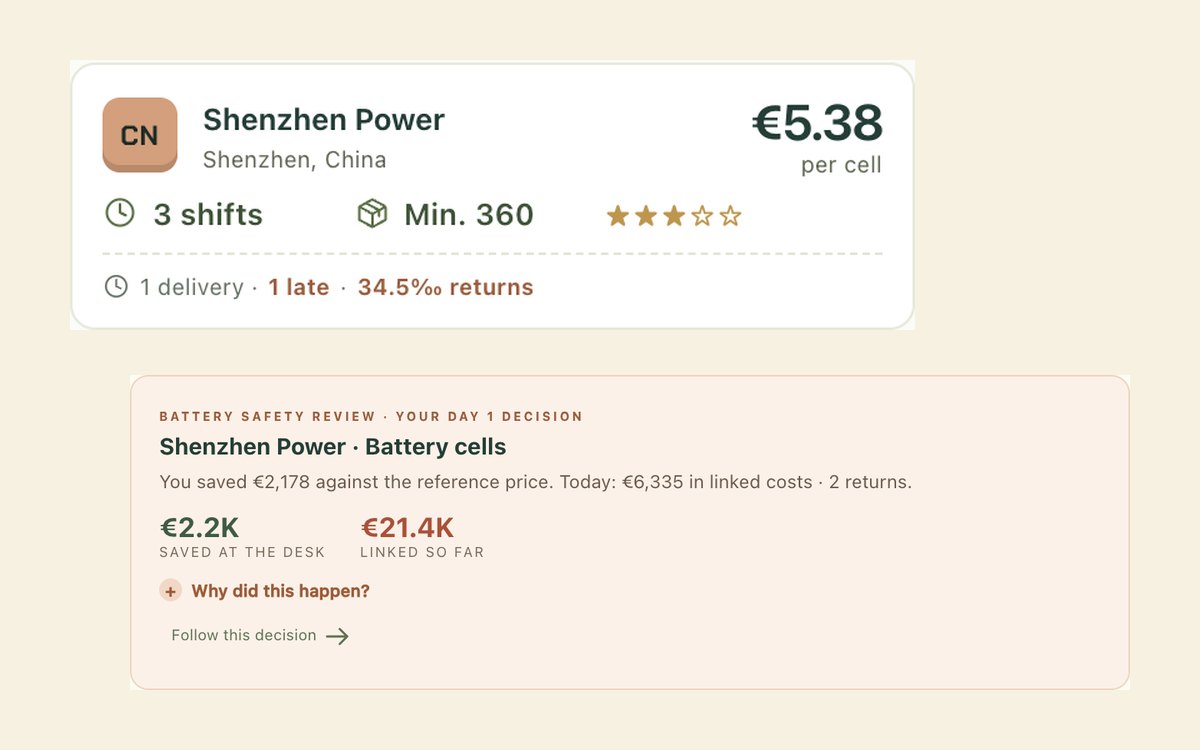
Two battery suppliers quote for 360 cells a shift. Supplier A asks €5.38 a cell; supplier B asks €7.80. Choosing A saves €2.42 a cell, about €2,200 over the first orders. That is the number on the purchase order, and it looks like a clear win.
Now add what happens next. If A’s cells fail one time in fifteen, some of those headphones come back weeks later. Each return costs the refund, the freight back, the handling and a mark against you with the retailer. If enough failures come from one order, a battery safety review follows. In Cargo & Consequence this exact story plays out: the shift report on day 22 links about €21,400 of costs to the day-1 order that saved €2,200.
The saving was real. It was simply smaller than the bill it created, and the bill arrived three weeks later, on someone else’s desk.
How to use TCO when choosing a supplier
- Compare suppliers on landed cost, not unit price.
- Put a number on quality: defect rate × cost per failure, including returns.
- Price the lead time: slower suppliers need more stock and more expedited freight.
- Keep a second source for critical parts, even if it costs more per unit.
- Look back: trace costs to the decisions that caused them, then update your scorecard.
Questions
What is total cost of ownership in procurement?
It is the full cost of buying and using a part or service: price, freight and duties, holding stock, inspection, failures, returns and supplier risk, not just the unit price.
What is the formula for total cost of ownership?
A practical version is TCO = purchase price + acquisition costs + usage and holding costs + cost of failures and risk. Add up each over the life of the product.
Why is the cheapest supplier often more expensive?
Low prices often come with longer lead times, higher defect rates or more risk. Those costs show up later as stock, rework, returns and emergency buying, usually outside the buyer’s budget.